
Prefer to watch? The film covers the same ground.
Quick answer
What are the best snooker cue tips?
For most players, the best snooker cue tips are well-made leather tips in a medium grade, trimmed flush to the ferrule and shaped to a tight dome. Soft tips hold chalk better and sound duller; hard tips keep their shape longer. Hardness changes the feel far more than the amount of screw or side you get.
Your tip has gone hard and shiny, the white keeps skidding off it when you screw back, and you wonder whether a new tip would sort it out. Maybe. The right snooker cue tips help, but the grade is only half the choice; fitting and shaping are the other half.
Talisman Billiards has made layered cue tips since 1999.
What Are the Best Snooker Cue Tips?
The best snooker cue tips are the ones that hold chalk, keep an even dome and suit the way you play. For most club players that means a leather tip, layered or solid, in a medium grade. Beginners do well on soft or medium. Players who chalk every shot and want a tip that keeps its shape can go harder.
Dr Dave Alciatore's guide to choosing a tip puts it more bluntly: as long as a tip holds chalk, you can play well with it. There is no magic tip. There is the wrong tip for you, and a good tip spoiled at the fitting.
Are Soft or Hard Cue Tips Better for Snooker?
Neither is better outright. A soft tip holds chalk better, sounds duller and feels softer through the cue, but loses its shape sooner. A hard tip lasts longer and keeps its dome, but needs more care to stay chalked. Struck at the same point and sent at the same speed, both put on the same screw and side.
You may think a soft tip grips the white for more screw. It doesn't. Dr Dave's tip hardness page shows no difference in spin between soft and hard tips at the same tip offset and speed, and no difference in how far from centre you can strike before a miscue, as long as the tip is properly chalked.
What a hard tip does is punish poor chalking. If it stops holding chalk, it can miscue closer to centre. Soft tips also firm up with use, and any tip plays harder the shorter it gets.
How the four grades compare, and which Talisman snooker ranges come in each:
| Grade | Feel and sound | Chalk holding | Shape and upkeep | Who it suits | Talisman snooker ranges |
|---|---|---|---|---|---|
| Soft | Softest in the hand, a dull thud | Best, and the most forgiving | Loses its shape soonest; firms up with use | Beginners, and players who want a forgiving feel | Trinity, Pro |
| Medium | Between the two | Good | Holds a dome with light upkeep | Most club players | Trinity, Pro, WB |
| Hard | Firmer, less of a thud | Less forgiving; tap it often | Lasts longer and keeps its shape | Players who chalk every shot | Trinity, Pro, WB |
| Extra hard | The firmest of the four | Holds chalk least of the grades; keep it tapped | Not tested separately; expect at least hard's shape-holding | Players who already know they like a firm tip | Pro |
More detail is in our cue tip hardness chart and our complete guide to cue tips.
What Are Snooker Cue Tips Made Of?
A snooker cue tip is a small disc of leather, built one of two ways. A solid tip is cut from a single piece of hide. A layered tip is built from thin sheets of leather glued together, meant to keep it playing the same as it wears down.
Dr Dave's page on layered tips is fair to both sides. Some players feel layered tips hold chalk less well, or that the glue between the layers affects how it plays, and without hard data he calls it a matter of preference. We make layered tips, so weigh our view with that in mind: our case is the same hardness from grade to grade and from one tip to the next.
Among layered-tip makers, Kamui says it makes tips for pool, billiards and snooker, and that its Standard tips use the part of the pigskin with the highest fibre density, marked SS, S, M and H. Moori calls itself the inventor and maker of laminated cue tips since 1983. We haven't tested either against ours. We won't pretend to rank them.
What Size Cue Tip Is Best for Snooker?
The best size is your ferrule's size. Talisman snooker tips are 10mm and need trimming flush to the ferrule after fitting on most cues. The tip is cut down to the ferrule, so it must start at least as wide.
Shape matters more on a tip this small. Dr Dave's page on tip size and shape quotes a player with a 10mm tip, close to a snooker tip, who says a tip that small needs a dime radius rather than a nickel. The two standard dome curves are named after American coins. The dime is tighter, and the choice matters most on very small tips.
Which Talisman Snooker Tip Suits Which Player?
All three Talisman snooker ranges are 10mm layered tips. Trinity, our flagship, is Japanese pigskin in soft, medium and hard. Pro is selected pigskin in four grades, up to extra hard. WB is water buffalo leather in medium and hard. Pro and WB come domed or undomed.
Side by side:
| Range | Leather | Grades | Packs | A good fit for |
|---|---|---|---|---|
| Trinity Snooker | Top grade imported Japanese pigskin, skived to even layers | Soft, Medium, Hard | 3, 9, 25 | Our flagship tip in a familiar grade |
| Pro Snooker | Selected pigskin | Soft, Medium, Hard, XHard | 3, 9, 25 | The widest choice of grade, or a tip that arrives domed |
| WB Snooker | Selected water buffalo leather | Medium, Hard | 3, 9, 25 | A medium or hard tip in a different leather |
If in doubt, start with a medium. You can go softer or harder next time, and Pro snooker tips run from soft to extra hard.
Why Do Good Snooker Tips Fail?
A good tip can be ruined at the fitting. Three mistakes ruin layered tips: shaping with a bladed tool, which can peel the layers apart; leaving the tip taller than the ferrule is wide, so heavy side can split it; and wetting the side wall when burnishing, which can separate the layers.
Bladed shapers. Trimming tools are generally fine for the diameter. The danger is in shaping, where the angle of a blade can delaminate a layered tip "much in the same way you can peel an orange". Use an abrasive dome shaper, as our cue tip shaper guide explains.
Height. Talisman suggests a finished side wall under one third of the shaft diameter, which is under 4mm on a 12mm shaft, and never taller than the ferrule is wide. A tall tip behaves like a tall building in a high wind: heavy side puts the force at the foundations, which on a tip are the bottom layers, and they can come apart or turn spongy. A snooker ferrule is narrower than a pool one, so the same rule leaves you less side wall.
Water and heat. Don't wet the side of a layered tip to burnish it, and keep heat down when you sand.
Talisman recommends a repairer for most players. Fitting your own? Our guide to replacing a cue tip works on a 10mm snooker tip too.
Key takeaways
- Medium suits most club players: soft forgives poor chalking, hard keeps its shape, and medium sits between.
- Hardness won't change your screw: struck at the same point and speed, soft and hard tips put the same spin on the white.
- Size to the ferrule, shape it tight: snooker tips are trimmed flush after fitting, and a tip this small wants the tighter dime dome.
- Fitting can ruin a good tip: no bladed shapers, no water on the side wall, and never taller than the ferrule is wide.
FAQ
How long does a snooker cue tip last?
Play decides, not the calendar. Replace it when almost no leather is left above the ferrule, or when it stops holding chalk and scuffing won't fix it. Hard tips generally last longer than soft ones.
What tips do professional snooker players use?
We won't name names. Talisman doesn't publish what individual professionals use. For a club player, grade and fitting matter far more than copying anyone's tip.
What glue do you use for a snooker cue tip?
Fresh superglue gel. A cue maker who has fitted hundreds of our tips uses it with ten minutes of steady pressure. Dr Dave says any CA gel works if it isn't old.
How do you shape a snooker cue tip?
With an abrasive dome. Hold a Willard's-style shaper on the floor between your feet, put the tip down into the dome and twist the shaft between your palms for about five minutes. Never use a bladed shaper on a layered tip.
Can you put a snooker tip on a pool cue?
Usually not. Talisman snooker tips are 10mm and pool tips 14mm, each trimmed to the ferrule after fitting. Dr Dave's size page gives 11 to 13mm as the normal range for pool tips, so a snooker tip is normally too narrow for a pool ferrule.
What should a snooker cue tip look like?
An even dome, flush. No lip at the ferrule. If the top has gone shiny, tap it before you reach for sandpaper: tapping helps it hold chalk, and scuffing wears the tip away fast.
Does a new snooker tip need breaking in?
A little. A new Talisman tip may take an hour or two of play to settle, with some light reshaping. After that it needs very little upkeep.
Related guides
- The complete guide to cue tips
- Cue tip hardness chart: soft, medium, hard and extra hard
- Choosing and using a cue tip shaper
- The best pool cue tips
From the Workshop
If you don't know what you want, buy a medium. I'd put that ahead of any brand advice, ours included. The usual reason for going softer is more screw, and the physics says that's the wrong place to look: chalk the tip properly, strike the white where you mean to, and a medium will screw the white back as far as your cue action allows. Hardness is about feel. And whatever you buy, keep the bladed shaper away from it.
Bottom Line
The best snooker cue tip is a well-made leather tip in a grade you can live with, trimmed flush to your ferrule and shaped to a tight dome. For most club players, that's a medium. Change hardness for feel, not for spin.
All three Talisman snooker ranges are 10mm layered tips with free worldwide shipping: browse our snooker tips.
Read next
Why Am I Miscueing? Seven Causes and How to Fix Each
Why you miscue in pool and how to stop: chalk, a glazed or flat tip, hitting too far off centre, a rushed stroke, and when the tip itself is finished.
Cue Tips: The Complete Guide
Cue tips explained by a tip maker: solid vs layered leather, pool and snooker sizes, hardness, shape, care, replacing, and which tip suits your game.
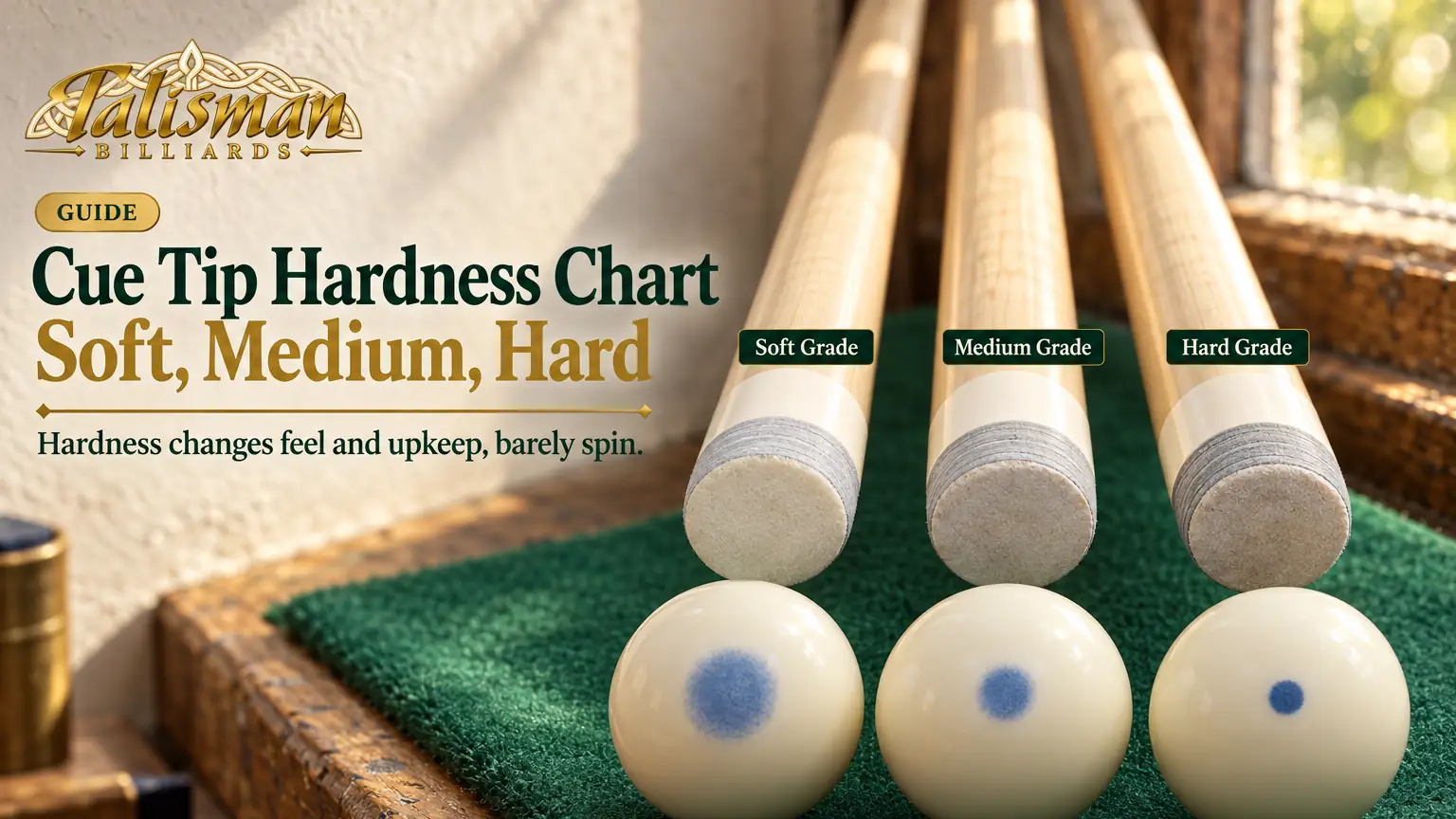
Cue Tip Hardness Chart: Soft vs Medium vs Hard
A cue tip hardness chart by feel, not invented numbers: how soft, medium, hard and extra hard tips compare on spin, chalk, shape and upkeep.