
Why Am I Miscueing? Seven Causes and How to Fix Each
By Tony Jones · 31 October 2026 · 8 min read
Prefer to watch? The film covers the same ground.
Quick answer
Why do you miscue?
A miscue happens when the cue tip slides off the cue ball instead of gripping it. The usual causes are poor chalking, a glazed tip that will not hold chalk, a tip worn flat, and hitting too far from centre. Check them in that order: chalk costs nothing, tapping or reshaping takes minutes, and your stroke takes practice.
You get down on a draw shot, hear a sharp click, and the cue ball goes nowhere you meant it to. There's a fresh mark on your tip. That's a miscue, and once you've had two in a night you start flinching at every shot that needs spin.
Talisman Billiards has made layered cue tips since 1999. You might expect us to blame the tip. Mostly we don't.
What Is a Miscue in Pool?
A miscue is a bad hit where the cue tip slides across the cue ball instead of gripping it. On a normal hit the tip grabs the ball and does not slide at all, as Dr Dave Alciatore explains on his miscue page. The WPA rules describe a miscue as usually coming with a sharp sound and a discoloured tip.
The WPA rules (rule 2.11) give two likely reasons: a contact that is too eccentric, or too little chalk. Eccentric means too far from centre.
So there are only two ways in. The tip met the ball where it could not grip. Or it could not grip anywhere.
Why Do I Keep Miscueing?
You keep miscueing because one of seven things is going wrong, and they are cheap to check in order: chalk, the tip's surface, its shape, how far off centre you hit, your stroke, a new tip that has not settled, and last of all a tip that is worn out or coming apart. Don't skip to the end.
Each cause, its symptom, check and fix, from cheapest to dearest:
| Cause | How it shows up | Quick check | The fix |
|---|---|---|---|
| Not enough chalk | Miscues come and go, worse on spin shots | Is the whole contact area covered after you chalk? | Chalk before every shot (chalk guide) |
| Glazed, shiny tip | Chalk won't stay on; the leather looks polished | Chalk it, then look for bald, shiny patches | Tap the surface; scuff only sparingly (tip tools) |
| Flat or worn shape | Miscues on spin shots even when chalked | Look side on: a flat top with square edges? | Reshape with an abrasive dome shaper (shaper guide) |
| Too far off centre | Miscues on draw and heavy side | Play a striped ball and read the chalk mark it leaves | Bring the contact point back in |
| Rushed or jabbed stroke | Miscues on draw even with a good tip | Do you snatch from backswing to forward stroke? | Smooth transition, accelerate through (holding the cue) |
| New tip not settled | Miscues on spin shots as the new dome flattens in the first hour or two of play | Was it fitted this week? | Play it in and reshape a little |
| Tip worn out or coming apart | Miscues that chalk and shaping no longer cure | Almost no leather left, a gap at the glue line, or spongy layers? | Replace the tip (replacement guide) |
The thirty second check before you blame yourself:
- Chalk the tip, then look at it. The dome should be covered right across.
- Tilt it to the light. Shiny, hard-packed leather is glazed.
- Look at it side on. You want a dome, not a flat top with square corners.
- Check the joint with the ferrule for any gap or lifted layer.
- Play a draw shot with a striped ball, stripe lined up with your cue, and read the chalk mark: it shows where you actually hit.
How Far Off Centre Can You Hit Before You Miscue?
Dr Dave Alciatore puts the typical miscue limit at half the ball's radius from centre. A standard stripe is half the ball's diameter wide, so its edges mark that limit, though he notes this is not true of every ball brand. Treat it as a guide, not a law.
His maximum spin page is blunter. A softer tip, a harder tip, a different brand of tip or chalk will not get you more spin. Chalk and a well-kept tip let you use all the grip there is. That's all they do.
Is a Miscue Your Tip's Fault or Your Stroke's?
A miscue is the tip's fault when the tip cannot hold chalk, has lost its dome, or is coming apart. It is your stroke's fault when a well-chalked, well-shaped tip still slides because you hit outside the limit. Checking the tip takes thirty seconds, so rule it out before you rebuild your stroke.
The tip problem that's easy to miss is glazing. Hitting the cue ball packs the leather down until the surface goes slick, and a slick tip does not hold chalk, as Dr Dave's tip care page explains. It's a bald tyre on a wet road: fine going straight, gone the moment you turn. Tapping the surface restores the texture. Sandpaper works too, but it wears the tip away fast, so tap more and scuff less.
Shape comes next. A flattened tip miscues because you end up hitting its square edge, says the rec.sport.billiard FAQ quoted on Dr Dave's tip shape page. A rounder dome can help at big offsets.
Then there's the tip that is breaking up. A layered tip left taller than the ferrule is wide takes a lot of sideways force from heavy side spin, and its layers can separate or go spongy, which is why our rule is never to leave it taller than the ferrule is wide, and ideally to keep the finished side wall under one third of the shaft diameter.
Why Do You Miscue on Draw and Side Spin Shots?
Draw and heavy side need a hit well away from centre, which puts the tip close to the miscue limit on every shot, so any small error pushes you over it: a little less chalk, a slightly flat tip, or a contact point a few millimetres lower than you meant.
Dr Dave's draw advice starts where this guide does: chalk before each shot. The rest is stroke. Don't rush from backswing to forward stroke. Keep your grip loose. Accelerate smoothly through the ball, and don't jerk the cue back after the hit.
Keep the back of the cue as low as the shot allows. Raising it costs accuracy, he says. For grip and bridge basics, see how to hold a pool cue.
Should You Reshape the Tip or Replace It?
Reshape when the leather is sound but flat: an abrasive dome shaper brings back the curve in about five minutes. A glazed tip only needs tapping. Replace the tip when it has worn down to almost nothing above the ferrule, when it won't hold chalk and scuffing won't fix that, or when the layers have come loose.
The first two are Dr Dave's. The third is ours, for layered tips.
Never reshape a layered tip with a bladed shaping tool. The blade angle can delaminate it, much in the same way you can peel an orange. Use an abrasive dome.
Key takeaways
- Chalk first: the WPA rules name too little chalk as one of two causes of a miscue.
- A glazed tip can't grip: tap the texture back, and scuff only when tapping fails.
- Half the ball's radius: Dr Dave's typical miscue limit, marked roughly by the stripe edges on many ball sets.
- Replace on evidence: worn to the ferrule, beyond scuffing, or with loose layers.
FAQ
Is a miscue a foul in pool?
Not on its own. An accidental miscue is not a foul under the WPA rules, but the shot still has to be legal. If the cue ball then hits the wrong ball first, or, with nothing potted, no ball reaches a rail, it's a foul as normal (rules 3.2 and 3.3), and so is clearly visible contact with the side of the cue (rules 2.11 and 3.7). Intentionally miscueing is unsportsmanlike conduct (rule 3.16c). League rules can differ.
Do harder tips miscue more?
Not if you look after them. Dr Dave says a well chalked, maintained hard tip should have the same miscue limit as a soft one. A hard tip that isn't holding chalk can have a limit closer to centre. Our cue tip hardness chart compares the grades by feel.
Does the brand of chalk matter?
Less than how you use it. Dr Dave says any commercially available pool chalk grips the cue ball without slipping, as long as the tip is holding it.
How often should you chalk?
Before every shot. That's Dr Dave's advice for draw, and it costs you two seconds on everything else.
Can a new tip make you miscue?
It needs settling first. A new Talisman tip may take an hour or two of play to settle, and you may need to reshape it a little in that time. Watch the dome while it does, because a flattened tip is one of the causes above.
Will a better tip stop me miscueing?
Only if yours is finished. A good tip, well shaped and chalked, gives you the full grip the physics allows. It won't fix a bad contact point or a snatched stroke. Start with our complete guide to cue tips if you're choosing one.
Is it the same in snooker?
Same causes, smaller tip. Snooker players miscue for the same reasons: not enough chalk, a glazed or flat tip, or a contact point too far from centre when you play screw or side.
Related guides
- The complete guide to cue tips
- How to chalk a cue properly
- Choosing and using a cue tip shaper
- How to replace a pool cue tip
From the Workshop
Most miscues are not the tip's fault, and I'd rather lose the sale than tell you otherwise. Chalk before you blame anything. If the chalk won't stay on, the tip is glazed: tap it and carry on. If you're still miscueing on a tip that's chalked, domed and sound, that's a stroke problem, and no tip I make will cure it. A new tip every few months won't fix a draw shot. Spend that money on table time.
Bottom Line
You miscue because the tip slid instead of gripping. Check the cheap causes first: chalk, then a glazed or flat tip, then how far off centre you are hitting, then your stroke. Replace the tip only when it is worn out, won't hold chalk after tapping and scuffing, or its layers have come loose.
If yours has reached that point, our pool cue tips are 14mm layered tips, with grades from soft to extra hard.
Read next
The Best Pool Cue Tips: Which Tip Suits Which Player
The best pool cue tips hold chalk, keep their shape and suit your feel. How hardness, layering and fitting decide which tip suits you.
The Best Snooker Cue Tips
How to choose the best snooker cue tips: soft, medium or hard, layered or solid, size and shape, and the fitting mistakes that ruin a good tip.
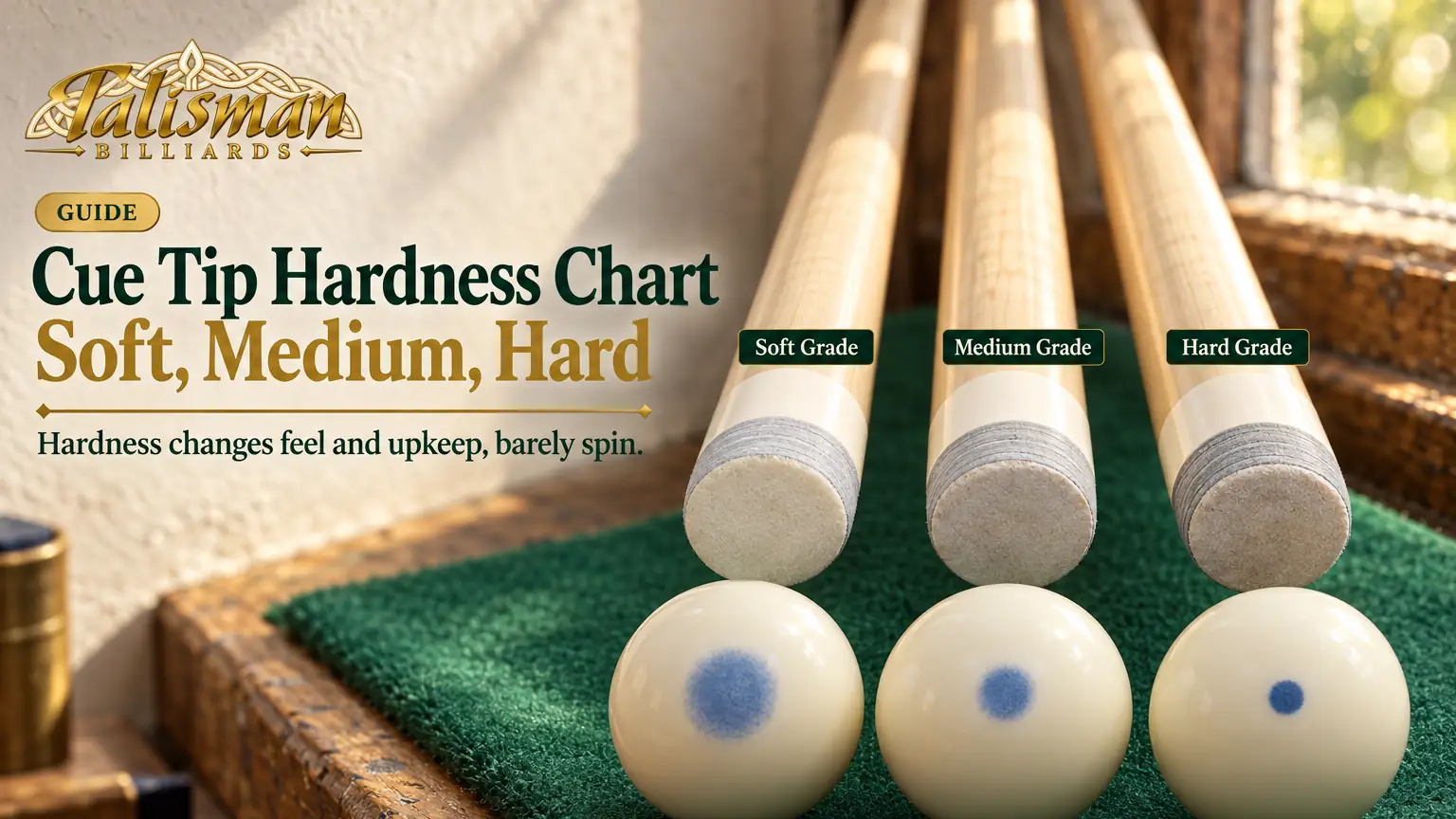
Cue Tip Hardness Chart: Soft vs Medium vs Hard
A cue tip hardness chart by feel, not invented numbers: how soft, medium, hard and extra hard tips compare on spin, chalk, shape and upkeep.