
Prefer to watch? The film covers the same ground.
Quick answer
What is the best pool cue?
The best pool cue is the one that suits your stroke, not the dearest one on the rack. For most players that means a straight two-piece cue of about 19 oz and 57 to 59 inches, a shaft that sits well in your bridge, a wrap you like holding and a good tip. Then stick with it.
You've had enough of the house cue. The tip is flat and shiny. The shaft wobbles when you roll it. You're ready to buy your own. Then you search "best pool cue" and find two kinds of page: shop grids with hundreds of cues, and brand rankings written by the people selling those brands.
This guide is neither. Talisman Billiards has made layered cue tips since 1999. We make tips, not cues, so there's no cue brand here to push. What you get instead is the order to decide things in, what each part of a cue changes, and where the tip fits in.
What Is the Best Pool Cue for You?
The best pool cue for you is a straight, solid cue whose weight, length and shaft feel right in your hands, fitted with a tip in good order. Brand and price come after that. Dr Dave Alciatore, who runs a large, advert-free site on pool physics, puts it bluntly: "Buying an expensive cue will not make you a better player."
His advice on selecting a cue boils down to three things. Pick what feels right. Make sure it's straight and sound. Then stop changing it, because your feel for pace and spin is built on one cue, not on a different one every month.
If you're new to the game, expect your taste to change as you improve, which is the honest case for a modest first cue: learn what you like on something plain and straight, find out which weight and shaft you keep reaching for, and spend more once you know.
Here's how the parts rank, in our view, and whether you can change each one later.
| Part | Typical choice | What it changes | How much it matters | Change it later? |
|---|---|---|---|---|
| Tip | 14mm pool tip trimmed to the ferrule; soft, medium or hard | Grip on the cue ball, chalk holding, feel and sound | A lot | Yes, replace it |
| Shaft | Maple or carbon fibre, about 12 to 13mm at the tip | Feel in the bridge, how far the cue ball squirts with side | A lot | On a two-piece, a new shaft |
| Weight | 19 oz is typical; most cues are 17 to 21 oz | Cue ball speed for the same stroke, and feel | Some: pick one and stick with it | With weight bolts, where fitted |
| Length | 57 to 59 inches; 58 is standard | Reach, and where your back hand sits | Only if you're tall or run out of cue | Yes, with an extension |
| Balance | Near the top of the wrap | How the cue sits in your hands | Little, unless you're very short | With weight bolts or an extension |
| Joint | Two-piece for carrying; one-piece in pool halls | Portability | Convenience, not play | Choose at purchase (our view) |
| Wrap | Irish linen, leather, rubber or none | Grip and feel in your back hand | Preference only | Ask a cue repairer (our view) |
What Weight Pool Cue Should You Use?
Use the weight that feels right across every kind of shot. Most pool cues come in 17 to 21 oz, with 19 oz the most common, according to Wikipedia's cue stick article. Dr Dave calls 19 oz a typical weight used by most people and a good starting point. Under WPA rules the limit is 25 oz.
A heavier cue sends the cue ball faster for the same effort, and some players find it easier to keep on line, though Dr Dave calls that a very individual thing, and one contributor on his weight page argues the differences are so slight that most good players adapt. Dr Dave also notes a heavier cue may carry more mass at the shaft end, which can mean more squirt, though not always. None of it is a reason to chase a number.
Most of the weight sits in the butt, often in the core under the wrap, and some makers fit weight bolts, usually metal discs of 1 to 2 ounces, so you can tune the total weight and the balance point to suit you.
Balance is where your height comes in. If you're shorter than most, a butt-heavy house cue can feel awkward. Dr Dave says balance "really isn't very important unless you are very short". Try a few. Don't fret.
How Long Is a Standard Pool Cue?
A standard pool cue is about 57 to 59 inches (roughly 1.5 metres) long. To check your size, address the cue ball: your back forearm should be at right angles to the cue. If you can't get it there with your hand on the butt, you need a longer cue or an extension.
Dr Dave treats 58 inches as the standard. Pass that at standard length and you're done. If you're tall, or you want more reach without gripping the very end of the butt, you may need more length, and an extension lets you try it.
Extensions come in two kinds. A butt extension screws onto the end and comes off easily during play. A joint extension goes between shaft and butt. Either adds weight and moves the balance, and Dr Dave warns that a joint extension can sometimes add a slight warp.
What Are the WPA Rules on Pool Cue Size?
The World Pool-Billiard Association sets only outer limits, not a standard size. A cue in WPA play must be at least 40 inches long, weigh no more than 25 oz and carry a tip no wider than 14mm. A metal ferrule may be no longer than 1 inch.
The WPA equipment specifications (section 17) give these limits for cues at WPA events:
| Measurement | Minimum | Maximum |
|---|---|---|
| Cue length | 40 inches (1.016 m) | None |
| Cue weight | None | 25 oz (708.75 g) |
| Tip width | None | 14mm |
| Metal ferrule length | None | 1 inch (2.54 cm) |
The same section says the tip must be specially processed leather or another fibrous or pliable material that can't scratch or damage the ball.
Which Shaft Diameter and Taper Should You Choose?
Choose the shaft that sits comfortably in your bridge. Most pool shafts finish about 12 to 13mm at the tip. A pro taper stays that width for the first 12 to 14 inches before it widens; a conical or European taper widens steadily from ferrule to joint. Neither is right for everyone.
Dr Dave points out that, despite its name, the steady European taper is the one on most North American bar and house cues. If you learned on house cues, that's the shape your hand already knows.
Diameter is mostly about your bridge hand. With a closed bridge some sizes and tapers feel better than others; with an open bridge it matters less. For spin, Dr Dave notes that a smaller shaft and a rounder tip are generally recommended.
Quality pool shafts are usually straight-grained hard rock maple. Snooker cues are almost always ash, a different wood for a different game.
Do You Need a Low-Deflection Shaft?
Not necessarily. A low-deflection shaft has less mass at its tip end, so the cue ball squirts less off line when you hit it with side. That means less aim correction on spin shots, which helps players who don't correct well. If you already play well with a standard shaft, switching means relearning your aim.
Picture two people brushing past your shoulder in a corridor, one empty-handed and one with a heavy bag on that side. The bag knocks you further sideways. The mass at the end of the shaft is that bag, and the cue ball is you.
Dr Dave's low-squirt shaft page lists the trade-offs fairly. In favour: fewer missed short pots when you forget to correct for side, and more consistent spin shots. Against: price, the time it takes to readjust, and with some shafts, harder jumps and massé shots. He's also clear that any extra spin you get from one is very small.
Many low-squirt shafts are carbon fibre or radial laminates, which are more likely to stay straight over the years. Carbon or wood, both work. Both still need a good tip.
One-Piece or Two-Piece: Does the Joint Matter?
For play, much less than buyers think. A one-piece cue is the simple kind pool halls stock for everyone. A two-piece cue splits in the middle so it travels in a case; if you play in a league, that's the one you want. Joint type mostly changes how quickly you can put the cue together.
Traditional joints screw fully together, newer quick-release pins are only half-threaded so the cue goes together and comes apart faster, and the fittings inside are almost always brass or steel because they move less with temperature than other materials. Pick by convenience.
Snooker cues are different again. Many are jointed two-thirds or even three-quarters of the way back towards the butt, which leaves an unusually long shaft and needs a long case.
Which Wrap Should You Choose?
Choose the wrap your back hand likes. Irish linen and leather both give grip and soak up sweat. Cheaper cues often use nylon, which many players think doesn't feel as good as linen. Rubber and foam wraps are a newer option, and some players want nothing but bare, polished wood. There is no right answer here.
If your hands get damp, go for linen or leather. If you grip too tight, no wrap fixes that; our guide to how to hold a pool cue will.
Why Does the Tip Matter So Much?
The tip is the only part of the cue that touches the ball, and it wears out. It decides how well the cue holds chalk, how it grips the cue ball on off-centre hits and much of what the cue feels like. A great cue with a glazed, flattened tip plays worse than a plain cue with a good one.
A tip maker telling you the tip matters most? You'd expect that. But the old rec.sport.billiard FAQ, which Dr Dave reproduces on his cue-selection page, says it plainly: "The tip has more effect on how the cue plays than the butt." The same FAQ puts the shaft first among the parts of a cue. Both are the working end.
What a tip can change:
- Hardness: it changes the feel and the hit, and harder tips hold their shape better than softer ones. Our cue tip hardness chart compares the grades by feel.
- Construction: layered tips hold their shape better than one-piece tips, which mushroom more easily. A layered tip can delaminate, though that is uncommon and usually comes from poor fitting or the wrong tools.
- Shape: a rounder dome on a slimmer shaft is the usual advice for spin.
A tip won't straighten a warped shaft, fix a cue that's the wrong weight or cure a stroke that wanders. Buy the cue for those things, and buy the tip for feel.
And if the tip on a new cue doesn't suit you, change it: the same FAQ's advice is that tips can be replaced. Our Pro pool tips, for example, come in soft, medium, hard and extra hard. Our complete guide to cue tips explains the choices, and the best pool cue tips guide helps you match one to your game.
Key takeaways
- Expensive doesn't mean better: Dr Dave's line is that buying an expensive cue will not make you a better player.
- 19 oz and about 58 inches: the typical weight and the standard length, and the place to start.
- Rules set limits, not sizes: WPA allows anything from 40 inches long, up to 25 oz, with a tip no wider than 14mm.
- Spend on the working end: the shaft and the tip change how a cue plays far more than the butt or the wrap.
FAQ
What is the best pool cue for beginners?
A plain, straight one. Buy something modest that feels right, then learn it. Your preferences will change as your game improves, so the big spend can wait until you know what you like. If you're still learning the rules, start with how to play pool.
What weight pool cue do most pros use?
About 19 oz on average. Wikipedia's cue article says professionals gravitate toward a 19 oz average, the same weight Dr Dave calls typical for most people. Pros choose by feel like everyone else.
Does a more expensive pool cue make a difference?
Not much to your game. Most of the extra money buys inlays, rarer woods and finish; the exception is a low-deflection shaft, which some players do benefit from. A good player plays well with any decent cue and a decent tip, once they know it.
How much does a decent pool cue cost?
Less than you'd think. We don't quote prices; they change. What matters is a straight shaft, sound joint and ferrule, a weight you like and a tip in good order, and none of those needs a collector's budget.
What's the best pool cue for the money?
A plain one, well chosen. Put the money into a straight maple shaft and a good tip before any inlay. A plain butt plays just as well as a fancy one.
Is a house cue good enough to learn on?
Yes, if you check it. House cues are often worn or warped, so pick carefully. Roll it on the table and reject any that wobble. Look for a tip and ferrule firmly attached with no cracks, and a tip that isn't hard and glazed, since a glazed tip won't hold chalk and is more likely to miscue.
Can you use a snooker cue for pool?
Yes, but it's not ideal. A snooker cue is usually a little shorter at 57 to 58 inches, made of ash and fitted with a tip of about 8.5 to 10.5mm for the smaller balls. Pool tips are wider. Talisman makes 14mm pool tips and 10mm snooker tips, and each is trimmed to the ferrule after fitting on most cues.
When should you change the tip on a new cue?
When it stops holding chalk. Or when it feels wrong. A tip worn low, glazed past saving, or simply not to your taste is worth replacing. Our guide on how to replace a pool cue tip covers it, though most players are better off paying a repairer.
Should I buy a cue online without trying it?
Only with known sizes. It's hard to tell whether you'll like a cue from a description; words like stiff, soft and forgiving mean different things to different people. Try cues at a club or hall first, then buy the weight, length and shaft size you liked.
Can I change the weight of my cue later?
Sometimes, with weight bolts. Some brands and most custom cue makers fit weight bolts that add or remove an ounce or two. Without them, choose the weight carefully at the start.
Related guides
- The complete guide to cue tips
- The best pool cue tips for your game
- Cue tip hardness chart: soft, medium and hard compared
- How to play pool
From the Workshop
Most people buy a cue for the butt and then play with the shaft and the tip. I'd do it the other way round. Get a straight cue with a shaft that sits well in your bridge, a weight you don't think about, and a good tip, and leave the inlays for later. Then stop shopping. Players who change cues every season never learn how any of them plays. The plainest cue in the rack, with a tip you trust, will do more for your game than the prettiest one with a glazed tip.
Bottom Line
The best pool cue is a straight one that feels right at about 19 oz and standard length, with a shaft that suits your bridge and a tip in good order. Spend on the shaft and tip before the butt, keep your first cue modest, and stick with whatever you buy long enough to learn it.
Cue sorted? Fit a tip that suits it from our pool cue tips, with free worldwide shipping.
Read next
Cue Tips: The Complete Guide
Cue tips explained by a tip maker: solid vs layered leather, pool and snooker sizes, hardness, shape, care, replacing, and which tip suits your game.
The Best Pool Cue Tips: Which Tip Suits Which Player
The best pool cue tips hold chalk, keep their shape and suit your feel. How hardness, layering and fitting decide which tip suits you.
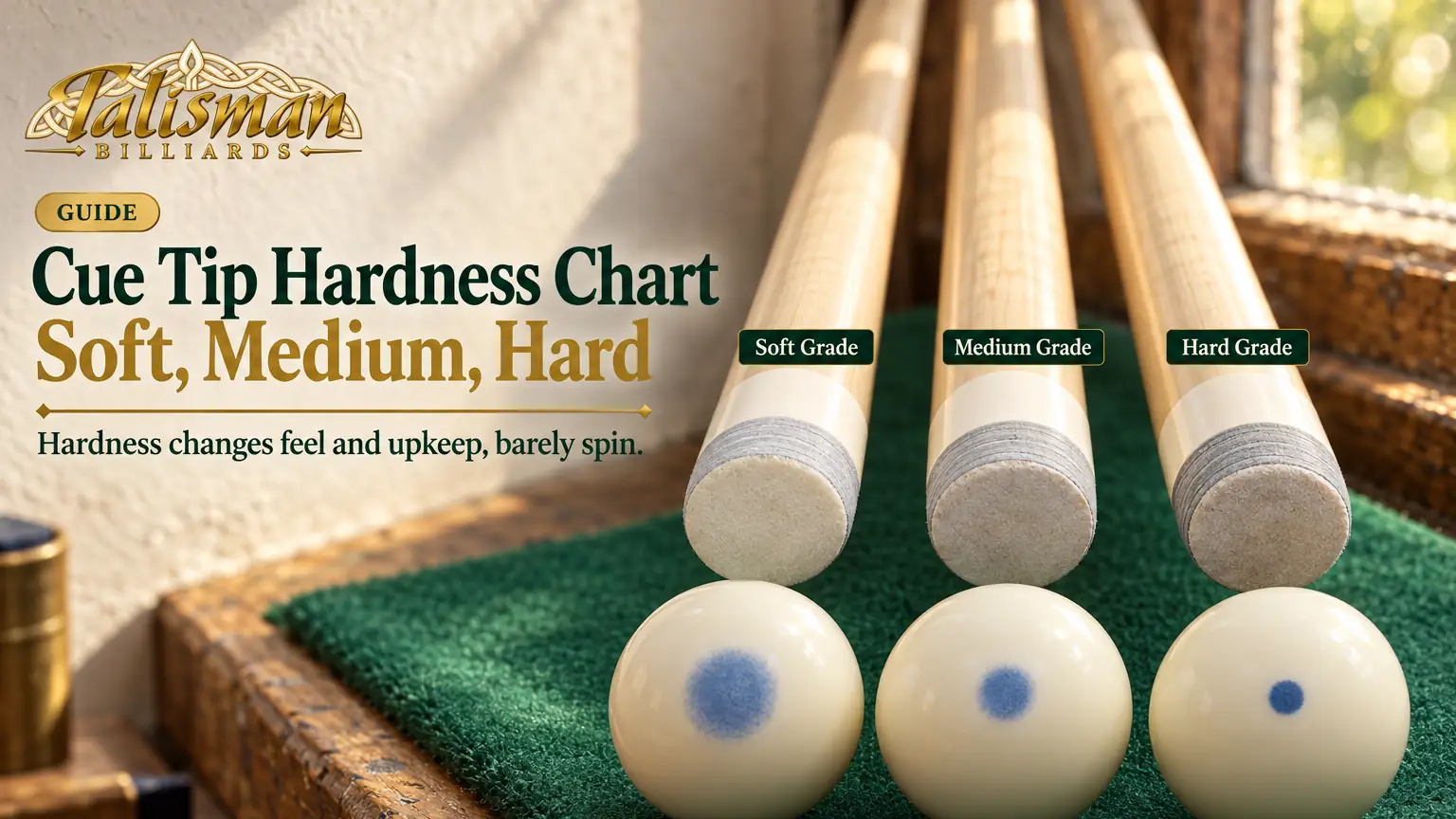
Cue Tip Hardness Chart: Soft vs Medium vs Hard
A cue tip hardness chart by feel, not invented numbers: how soft, medium, hard and extra hard tips compare on spin, chalk, shape and upkeep.