
How to Rack Pool Balls Properly, Game by Game
By Tony Jones · 31 October 2026 · 8 min read
Prefer to watch? The film covers the same ground.
Quick answer
How do you rack pool balls?
Here is how to rack pool balls for 8-ball: set the triangle with its front ball on the foot spot, the 8 in the middle of the third row, one solid and one stripe on the two back corners, and the rest at random. Push the balls tight so each one touches its neighbours. Other games fix different balls.
The balls have dropped and you're holding the triangle. Most people know roughly how to rack pool balls; fewer know which balls the rules fix, and that the answer changes from game to game.
The rules here come from the World Pool-Billiards Association's Rules of Play, effective 21 October 2026, with league and UK rules marked.
Where Does the Front Ball Go When You Set Up Pool Balls?
The front ball of the rack, also called the apex or head ball, goes on the foot spot: a point on the line down the middle of the table, a quarter of its length in from the foot rail. Two WPA games differ: in 9-ball the 9 takes the spot, and in blackball the black does.
In APA league play the front ball takes the foot spot in every game.
No mark on your table? The WPA says the diamonds mark eighths of the length, so the foot spot sits level with the second diamond from the foot rail, halfway across.
The common slip is racking at the wrong end. Leave the head spot, at the end where the cue ball usually starts, empty.
How Do You Rack 8-Ball?
To rack 8-ball, put all fifteen object balls in the triangle with the apex ball on the foot spot. The 8 goes in the middle of the third row, directly behind the apex ball. One solid and one stripe sit on the two back corners. Under WPA rule 4.2, everything else goes in "without purposeful or intentional pattern".
Think of an 8-ball rack as three nails and a pocketful of loose change: the nails are the 8 and the two back corners, fixed by the rules, and the change goes anywhere you didn't arrange on purpose. Our guide to pool ball colours and numbers shows which are solids and which are stripes.
The APA racking rules ask only for the 8 in the centre. The corner rule is the WPA's. Do the corners anyway: that rack is legal under both.
How Do You Rack 9-Ball?
Rack 9-ball in a diamond of nine balls, in rows of one, two, three, two and one. The 1-ball goes at the front point, facing the head of the table, and the 9-ball goes in the middle. Under WPA rule 5.2 the 9 sits on the foot spot; under APA league rules the front ball does.
That moves the whole diamond, because with the 9 on the spot the 1 sits two rows in front of it, towards the head of the table, where an APA rack would have the 1 on the spot itself. Same balls, different place on the cloth.
Under APA rules, the other seven go in any order.
How Do You Rack 10-Ball?
Rack 10-ball in a triangle of ten balls, in rows of one, two, three and four. WPA rule 6.2 puts the 1-ball at the apex and on the foot spot, and the 10-ball in the middle of the triangle. The other eight go in without purposeful or intentional pattern.
The 10 is the only ball that doesn't touch the edge.
How Do You Rack Pool Balls in English Pool?
In English pool, also called blackball, the black goes on the spot, in the middle of the third row. WPA rule 8.4 racks the balls "as illustrated" with the black on the foot spot, and the World Eightball Pool Federation rules put the black on the spot and the rest "as per diagram". The two diagrams match.
Read from the front, as drawn, both show:
- Row one: red
- Row two: yellow, red
- Row three: red, black, yellow
- Row four: yellow, red, yellow, red
- Row five: red, yellow, yellow, red, yellow
So a red and a yellow take the back corners. With the black on the spot, the front ball sits two rows in front of it, towards baulk. WPA rule 8.2 also allows solids and stripes in place of reds and yellows.
What Are the Racking Rules for Each Game?
The American games fix only a few balls: in 8-ball the front position, the 8 and the two back corners; in 9-ball the 1 and the 9; in 10-ball the 1 and the 10. The rest go where they land. Blackball is the exception: every ball follows the diagram. Rack them all tight.
Each game's rack, by the rules:
| Game | Balls | Shape (balls per row) | On the foot spot | Placed by rule | Rule |
|---|---|---|---|---|---|
| 8-ball | 15 | Triangle, 1-2-3-4-5 | Apex ball | 8 in the middle of row three; one solid and one stripe on the back corners | WPA 4.2 |
| 9-ball | 1 to 9 | Diamond, 1-2-3-2-1 | 9-ball (WPA); front ball (APA) | 1 at the front, 9 in the middle | WPA 5.2, APA |
| 10-ball | 1 to 10 | Triangle, 1-2-3-4 | 1-ball | 1 at the apex, 10 in the middle | WPA 6.2 |
| Blackball (UK) | 7 red, 7 yellow, black | Triangle, 1-2-3-4-5 | Black | Black in the middle of row three; a red and a yellow on the back corners; the rest as the diagrams show | WPA 8.4 and p.33 diagram, WEPF F(1) |
The mistakes that break those rules:
| Mistake | Why it's wrong | Rule |
|---|---|---|
| 8 at the front or on a corner | The 8 goes in the middle of row three | WPA 4.2 |
| Two solids or two stripes on the back corners | One from each group goes there | WPA 4.2 |
| 1-ball on the spot in WPA 9-ball | The 9 takes the foot spot | WPA 5.2 |
| Template left on the rail | A ball touching it is a foul | WPA 3.15 |
Step by Step: How to Rack Pool Balls Tightly
A tight rack is one where every ball touches its neighbours. APA league rules ask for balls "frozen (touching) as tightly as possible", and the WPA says "as tightly as possible" for 8-ball, 9-ball and 10-ball. Dr Dave Alciatore's first advice is to find where the front ball wants to settle.
You will need:
- a rack: a triangle, or a diamond for 9-ball
- the balls for your game
- a racking template, only where your rules allow one
From Dr Dave's page on getting a tight rack:
- Settle the front ball on the spot, find where it wants to sit, and rack the others behind it. Dr Dave rates this probably the most important advice.
- Push the balls towards the centre from the back, and down, so they freeze together.
- Tap any edge ball that rolls out back into place with another ball or with the rack.
- Turn or swap balls to close a gap.
- Lift the back of the rack first, then slide it forward, away from the front ball.
- Brush or wipe the cloth in the rack area if the balls still won't sit.
Some sets never freeze. Dr Dave says old, worn balls may make a perfectly tight rack impossible. If yours won't freeze, do your best and break.
Where your rules allow a racking template, Dr Dave says it can give the best rack possible, but put it somewhere sensible afterwards, because under WPA rule 3.15 a ball touching a template lying on the rail is a foul.
Then break. For the flashier version, read what a jump break is.
Key takeaways
- The foot spot anchors the rack: the front ball sits on it in 8-ball and 10-ball, the 9 in WPA 9-ball, the black in blackball.
- Three balls are fixed in 8-ball: the 8 in the middle of row three, plus one solid and one stripe on the back corners.
- Random means not arranged on purpose: the WPA wording is "without purposeful or intentional pattern".
- Tight beats tidy: push from the back, tap stray balls in, lift the rack back first.
FAQ
Who racks the balls in pool?
In APA league play, the loser. The loser of the lag, and then the loser of each game, racks for the opponent.
Can the breaker ask for a re-rack?
Yes, in APA play. The breaking player may request and receive a re-rack. Check the rack before you break, not after.
What does "frozen" mean when racking?
Balls touching each other. APA asks for balls "frozen (touching) as tightly as possible", so a gap anywhere means the rack isn't frozen.
Which balls do you use for 9-ball on a coin-operated table?
Usually 1 to 9. APA rules let teams on coin-operated tables swap unused balls 10 to 15 in for pocketed ones after a short game.
Can you use a racking template?
Where your rules allow one. WPA rule 6.2 points to its template regulation for 10-ball, but the WPA rules out templates for straight pool and one-pocket.
What happens if the black goes down on the break in English pool?
Under WPA and WEPF rules, a re-rack. All the balls are racked again and the same player breaks. International 8-ball rules differ: the black is re-spotted, and if other balls went down on an otherwise legal break, the breaker carries on.
Related guides
From the Workshop
I make cue tips, so I have a soft spot for small jobs that decide a frame. The rack is one. The two faults I'd watch for are gaps and an 8 in the wrong place, and both are easy to miss when you've waited your turn, you're keen to break and the rack looks perfect from the far end of the table. Walk round and look again. In blackball, learn the diagram rather than guessing.
Bottom Line
Put the right ball on the foot spot, place the two or three balls your game fixes, and drop the rest in with no pattern; in blackball, copy the diagram ball for ball. Then push everything tight. That's a legal rack in every game here.
Next, read how to hold a pool cue. Talisman Billiards has made layered cue tips since 1999. You'll find our pool cue tips in the shop.
Read next
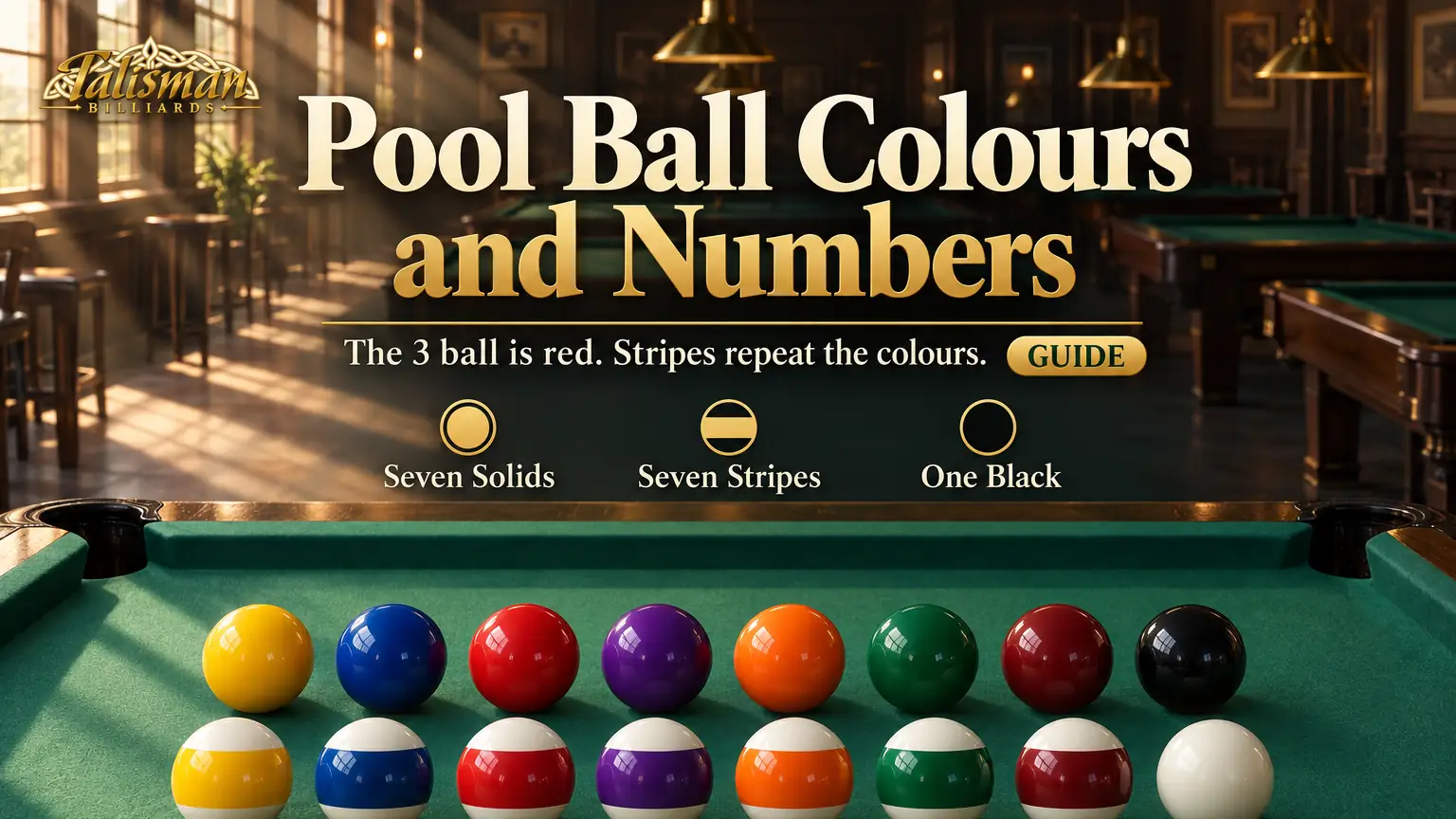
Pool Ball Colours and Numbers: The Full 1 to 15 Chart
Pool ball colours and numbers from 1 to 15: the 3 ball is red, solids and stripes, why the 4 looks pink on TV, and the UK red and yellow set.

How to Play Pool: Rules, Stance, Stroke and Aim
How to play pool from the first rack: 8-ball and 9-ball rules, fouls, stance, bridge, a straight stroke, ghost-ball aiming and drills to practise alone.

The Best Pool Cue Tips: Which Tip Suits Which Player
The best pool cue tips hold chalk, keep their shape and suit your feel. How hardness, layering and fitting decide which tip suits you.